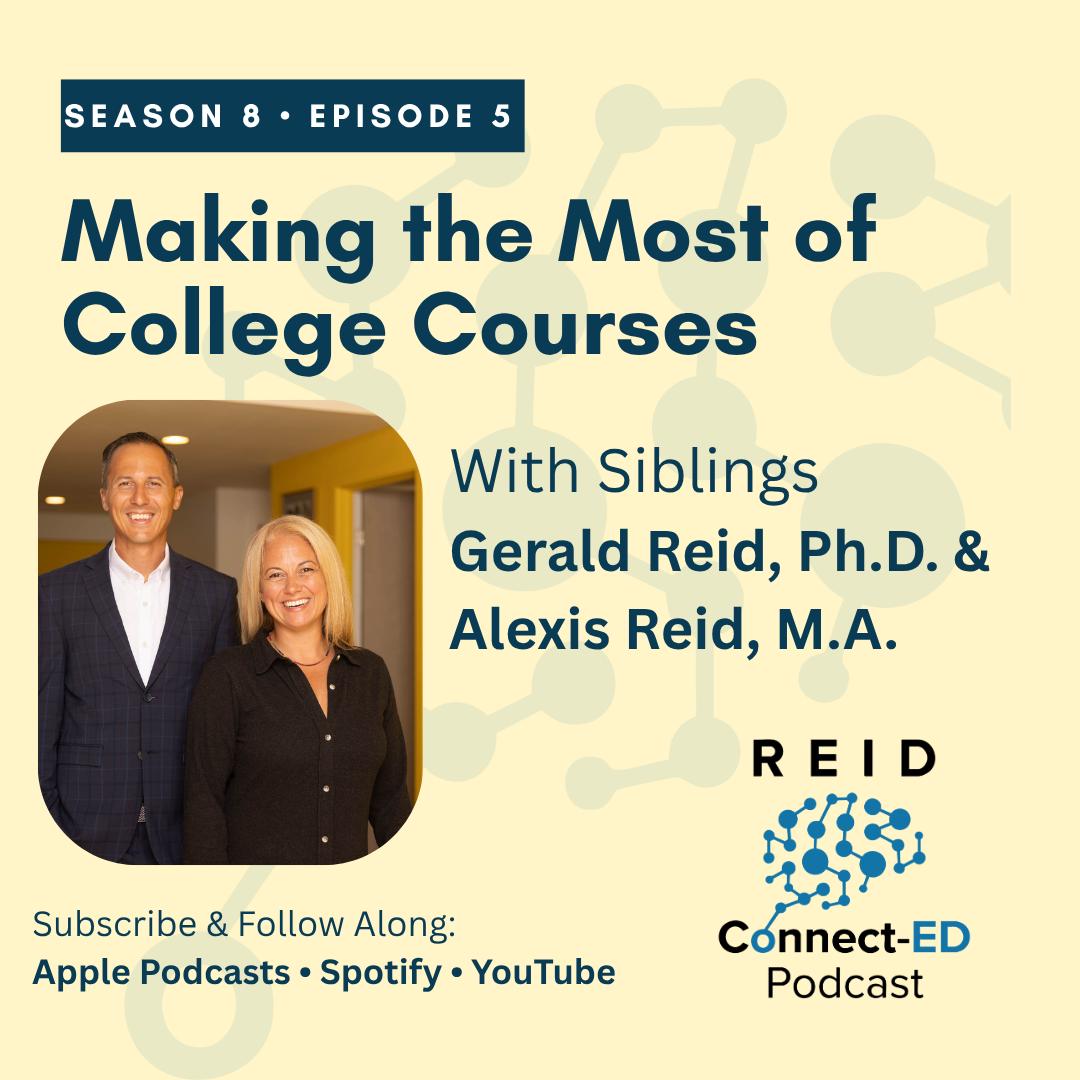
S8 E5: Making the Most of College Courses
Listen Now!
-
-
First and foremost, teaching is a very difficult task, especially in the day of social media and technological distractions and attention spans decreasing. This episode is a discussion to help consider how professors and students can make the best of a college course.
College is a time when students are very much on their own for the first time. This means there are executive functions and self-regulation skills that are required to navigate college courses.
College professors may be experts in their field or have familiarity with the content; however, they may not necessarily be trained as teachers about the learning process.
Executive functions can get looked over and not be part of the way courses are designed.
Automaticity is when you practice something over and over and over-learn something so that it feels more automatic and requires less conscious effort. However, with AI, students are relying on technology to make tasks automatic but not through their own brains. Students with AI tend to prioritize ‘getting to the outcome’. Alexis calls it a “cheat code” that students use to get to the end result.
Our prior episode with Dr. Luis Perez was about how teachers can integrate AI in a way that is effective and ethical. Season 5, Episode 7
Alexis finds that students may be rushing to outcomes so often that they are not actually retaining or benefitting from the course experiences.
In the competitive environment we live in, people don’t want to be left behind as AI advances; however, it can be a slippery slope of deep learning and engagement in the learning process. This was discussed with Dr. Maryann Wolf. Season 7 Episode 9
AI is very effective in helping people gather information instantaneously. However, it does not mean that students can integrate the information, put it into a larger context, and utilize the information in an effective, appropriate, and even ethical manner.
Professors can appreciate how important they are to inspire their students and teach through their own personal wisdom and experience rather than just transmitting information to the students.
There are plenty of benefits of AI teaching in the sense of individualizing and going at one’s own pace. However, as Dr. Luis Perez talked about - it lacks personalization.
It is important to ask the question “What is the goal of a course?”
It is important to share information within a larger context. Not just ‘grabbing at’ information that is out there via AI, which may simply be forgotten shortly thereafter, especially with the amount of distraction and overstimulation on their phones that students are exposed to.
It is important for students to understand the questions to ask as they seek out information. They also need to understand how to integrate information into their critical thinking and approach to a problem, situation, and context. There is also the importance of executive functions like prioritizing, reflecting on one’s own thinking about the information, and so forth. A student can have access to all the information in the world but it won’t matter without these executive functions being activated. And students are so reliant on technological convenience that they may not be utilizing and developing their executive functions.
Each semester is like a new adventure as it will never be the same context with each student in time, people, and place. It is a creative process to make shifts not only before starting a new semester. Even mid-semester it helps to openly ask students for feedback so that tweaks and adjustments can be made to improve the learning engagement and effectiveness. Students may be so accustomed to just being compliant that even being asked what they need; however, reflecting on what they need may be essential to understanding their own learning process and even engage them in wanting to learn.
Keeping a course fresh helps the professor stay engaged in the learning and not just go through the motions.
It is important that students, especially with the access to AI, not believe that she should know everything but rather have the humility to admit they do not know something and ask their burning questions. This maintains engagement and curiosity.
Gerald talks about how he will do role-play counseling sessions, pause the mock session, and invite students to ask questions of what he is thinking and feeling in certain moments of the mock counseling session. This helped students to engage their meta-cognition, which is thinking about their own thinking. Gerald models that for the students by talking about his own thinking and feeling process in the middle of the mock counseling session.
A syllabus may be structured to just go from one topic to another week by week rather than connecting the information to each other. This can make the learning less cohesive and connected.
Rather, it is important to find ways to relate new information to background information. This helps to prime the brain to be ready for what new information is about to be presented. It also helps the student see how the new information fits into a larger context.
Alexis shares how when going through the syllabus the students are encouraged to map out a vision for how they can manage their time to complete each task throughout the semester.
Professors can also break down larger tasks into smaller chunks since students may wait until the last minute if there is simply a large task due at a longer date. The students may actually get a ‘good grade’ by procrastinating and finishing bigger projects or tasks at the last minute, which can reinforce the behavior of procrastination because “it worked” they will say.
Alexis encourages professors to not just have 2 exams throughout the entire semester. Students could think “there’s not that much work” but then realize they need to manage their time and energy to prepare effectively. They can have a false sense of comfort that it’s “only 2 things” to do for the semester without realizing how much work it will actually take. Rather, it can help to make more formative check-points and opportunities to monitor their progress throughout the semester.
It can help to even just have dialogue with students about what they have learned, what is working or not working in their approach to the course, and their take-aways periodically throughout the semester. The purpose of the classroom could actually be just that - a space to invite reflection, discussion, and the ability to think critically together. Information that is lectured at students could simply be accessed through AI at this point, so it may be time to reconsider the purpose of the classroom as an experience for learning and engagement in learning.
Ideally, colleges will feel like a real community; a space and place where students want to be in the classroom. There is so much pressure to ‘be a certain way’ and perform for others that can interfere with genuine connection.
AI can be considered an “assist” not to do the work for them.
Professors can have candid conversations about executive functions with their students. Many students may not even think much or critically about how executive functions relate to their learning.
Gerald talks about his use of graphic organizers in content heavy courses. This is a scaffolding that helps guide the way in which students write notes. Otherwise, they are left with a blank page or digital page without having much structure or clarity as to what, how, and why they can take notes. It also helps to make essential information explicit and allow for additional notes and other content to be written under that essential information. It helps them look for what is essential and important, which can be very confusing for students.
Alexis talks about the importance of prioritizing time, resources, and energy throughout the semester instead of just ‘pushing through’ to ‘get through’ all the content. Doing so can help the flow of the course and make connections between new information presented to them. It also helps the students feel more seen and appreciated by professors acknowledging the importance of this.
It is not easy to create and implement an effective college course. However, putting the work up front is often the hard part so that you can feel prepared to be flexible and adaptable throughout the semester. It does not mean to individualize every single thing done in every class; however, it is important to create flexibility to access and engage students. It can help to give an example of what it would look like to manage time and demonstrate progress; like presenting an exemplar. Providing practical applications to the material is also often helpful. Again, it can help to check in with students about what has worked and been effective for the students to make connections with the material and content presented to them. Our brains are constantly looking for patterns and associations to learn.
You can learn from the bottom-up by helping students to observe, notice, and discuss to create from that place of curiosity and recognition.
Socratic questioning is a common practice to use questions to guide the learning rather than just telling the students and regurgitating it back.
-
Gerald Reid 00:06
Welcome back to Season eight of the Reconnected Podcast, co-hosted by myself, licensed psychologist Dr. Gerald Reid, and my sister, educational therapist Alexis Reid.
Alexis Reid 00:17
Today we're going to delve into a topic that doesn't always get discussed, or maybe it does, just not in the context we're about to dive into today. We're going to talk about college and university level studies, because you and I both work with a lot of college age students, a lot of which are either in undergraduate or graduate studies, and you even teach a graduate studies course, and I, an undergraduate course, and what we find is there are a lot of young people struggling to find true connections to the work that they're doing, even after they're paying so much money to be a part of these communities, universities, and their studies. Sometimes it makes it tricky for them to know how to fully invest themselves, not just to get through the tests or the assignments or their coursework, but to really deeply learn, because essentially, when you go to some version of higher education outside of what's required of you to go through high school, you know you're studying to prepare for your future, and in this day and age, right now, we're in May 2026 There's a lot of uncertainty around the future, especially with AI and digital technologies and different ideas happening in the workforce that maybe we can't even predict what's to come or what the job markets can even look like. So I really want to talk a lot more about how we help not only the students and the families, but also the professors and those who are leading the coursework and those who are a part of higher education to think differently about their design, the way in which they engage their students, and how we really support students not just to get through a college degree or program, but to really make the most of their time, that is such a formative time between adolescence and young adulthood.
Gerald Reid 02:13
Yeah, and especially a time in life when you're really on your own once you go to college, you know, there's no like one adult in the person's life once they go to college, that's really looking out for them. There could be an advisor, but you know, look at big colleges, the advisors could have, like, so many students, you know. So we like to think that professors in a classroom have such an important role. It could be such an enriching experience that has the potential to be, and Alexis, you know, we, we understand the context of higher education is that professors are not necessarily trained in how to be teachers, right? They are sometimes experts in their field, or have, you know, found their way into higher education to teach a course of content they're familiar with, and it is so crucial and important being a student and being on the other side of it, of teaching is to find ways to support, like you said, the engagement of deep learning, and as you always point out, the executive functions that can get looked over or glossed over, and how important that is to really fully being a part of the curriculum and getting the most out of it, because as we've seen in the people we've worked with, and just, you know, just this is just how it works, is that if people, students, struggle with executive functions in the classroom, they can really, it's a slippery slope, they can really fall behind, they can have a lot of that shame cycle you talk about, and so today we really want to talk about how to support the executive function in the classroom that really, you know, supports their learning and their deep learning and their engagement in the process, and hopefully the students can learn ways they can use executive function skills in the classroom as well.
Alexis Reid 03:53
Yeah, so for the conversation today, I think the framework is really going to be focused on how do we design better, right? How do college professors design their courses better through the lens of executive function and universal design for learning to make things more flexible, and also, if you're a student listening, how can you design your day and your experience a little differently and a little better? And if you're a caregiver or a parent or even an educator of a younger student, how can we actually like think of how we scaffold these skills, so when you get to college or any level of higher education, you can really make the most of it. I think that's really the goal. And for all of you out there who might be graduating this May, as we're going into a weekend full of college graduations here in Boston, especially,
Gerald Reid 04:40
congratulations,
Alexis Reid 04:40
you can't turn a corner without seeing somebody in their cap and gown, but, but I want you to also, if you're listening, think about how you learn best, whether you are going to go on to graduate level work and studies, or maybe just learn how to adapt to your new job. We have a great episode, we talked a little bit about the transition into the. Workforce, but really we learn best by reflecting on our experiences. So we're going to bring you back to college, or if you're there right now, we hope that this will help you to think a little differently about your experience and how to make the most of your time while you're an undergraduate student. I
Gerald Reid 05:28
Let's set the stage for a college student these days in the world of AI. More specifically, the fact that AI can give you so many answers. You work with students, they obviously use AI now, they just do, right? And there's some benefits to it, in terms of organizing and finding information efficiently, and all that. And at the same time, it's become a shortcut to getting to the end goal. And so we want this episode to be about, you know, if you're a professor and if you're engaged in the classroom, how can you make learning more engaging, more, more of an investment in the learning process itself? Because we have seen so many times that students nowadays are kind of just getting to the end, and that's part of perfectionism too, is they want kind of like the perfect, you know, outcome, and they want it immediately, because there's like perfectionism matched with, you know, difficulty delaying gratification. It's like a perfect storm of basically, you know, young people nowadays wanting perfect and wanting it immediately. It's like that's not the way life is, and that's actually, you know, detrimental to their learning and their engagement learning.
Alexis Reid 06:36
Yeah, you and my clients know that I talk a lot about this idea of automaticity, right? Our brains want things to be automatic, and the more we practice, the more automatic we become at taking on any skill or task, right? The more we practice it, the more automatic becomes. The more you practice your skills on an instrument, the more you can play them and integrate them in different ways, right? But in our world today, everything's automatic in that you can push a button and get a result rather than putting in that time and focusing on the process of getting to where you're headed, and I see this so often, and I know you do too, with your students, and also with the clients you work with, a lot of young people see AI sort of like a cheat code, right? I was interviewed for an article that came out, I think it was December 2024 Myself and Luis Perez were interviewed to talk about how students with learning disabilities can benefit from AI, and in it I was quoted saying that, you know, a lot of young people think of AI as finding a cheat code to get to where they're aiming for in school, and I was telling the reporter that, you know, they're just doing this anyway. How do we help them to understand how it could leverage their abilities rather than becoming a thing that thinks and does for them, right, and I think with every technology, you know, if you move on from like a pencil to a pen to the computer, right, a calculator, right, there's all different levels of evolution, especially with technology, and technological disruption can feel uncomfortable as it's happening, but there's a lot of great benefit, as long as we keep in mind some of the ethical consequences, and we had a great episode with Luis Perez talking about that, and this, that will not be the only one that we bring on the podcast to talk about, but, but I want us to think about how we meet students where they are, where they're not just like sneaking using AI, because a lot of my students who use AI to summarize an article or a chapter to be prepared for class or to answer questions they've been asked.
Gerald Reid 08:49
Yeah,
Alexis Reid 08:50
they often on the other end of getting through that semester will say, I feel like I'm dumber because of being in school right now. Wow, and the way I just did school,
Gerald Reid 08:59
and I'm like, that's like the opposite we would expect,
Alexis Reid 09:02
totally right. It's unbelievable, and you're investing so many resources, so much time, so much effort into showing up for college, and we'll talk more about the structure and schedule of the day later.
Gerald Reid 09:13
Yeah,
Alexis Reid 09:13
but if you're investing in this experience, shouldn't you get something out of
Gerald Reid 09:18
it? Yeah, I mean, it's interesting, because, like, technology is moving so fast. I think people in the competitive environment we live in now, that it's almost like nobody wants to be left behind, and I totally understand that, you know, it's like you want to, like, stay with the times and keep up, and technology is going to help propel people to a higher level, but at the same time, like, that's, I think, a slippery slope of forgetting the core elements of our brains and our ability to process information, our ability to learn more deeply. As we talked with Dr. Marianne Wolfe, is like when you're reading a book, if you're not deeply learning it, if you're not deeply engaged in it, you're not going to get anything out of it. You may just get some rote memorization of some facts or information. Yeah, but you're not really understanding the deeper meaning and fully integrating it into your thought process, and so much of learning is how do you integrate information. I want to give a quick example. When I'm teaching therapists, they can use AI to learn all about different theories, they can learn about cognitive behavioral therapy, psychodynamic therapy, emotion-focused therapy, they can learn about. Okay, if this person has depression, what's the best treatment? Whatever.
Alexis Reid 10:27
Yeah,
Gerald Reid 10:27
like any information, by the way, isn't that wild? Yeah, you can learn anything.
Alexis Reid 10:34
Well, right, that's why I always say, you know, and I'm just going to jump in for a moment, because it's such a good point, and I tell the students I work with their families and the educators I work with, too. I say, you know, these kids today can learn any - we all can learn any content we want by googling or going to chat or AI to like answer any questions we have. Like, the content acquisition is not actually the goal anymore, right? So, if that's so easily accessible,
Gerald Reid 11:04
yeah,
Alexis Reid 11:05
what are we doing in spaces of higher education? Yes, like, what is the goal? And I always say that the important part, the most important aspect of college, especially during this formative time developmentally, is to build relationships to learn from the professors and their wisdom, their experience, their, you know, their, their studies, their research that they've done. Have these conversations with people who only think about this one subject for the majority of their days to glean like a different level of understanding or hopefully inspiration that helps guide these young people to figure out what they really want to do in their lives.
Gerald Reid 11:44
There's no doubt the relationship is essential, right? You're not gonna be inspired by a robot or an AI teacher, you know? Like, how is that a single glimmer? But
Alexis Reid 11:52
there was a new study, actually, that I just saw came out, and I haven't read it yet, but it was talking about Scott Barry Kaufman was posting about it, that that AI is making more like flat, mutable, creative experiences that they were quote unquote creating and being creative, but it was more of the same, which is like a, like a reproduction of things rather than an extension of things.
Gerald Reid 12:14
Totally right, because it's like create the creativity that AI is making is like eventually going to kind of morph into one thing. It's kind of like, how, like, there is no culture anymore. Every culture is like, every, everything is everything now. So, everything kind of just becomes one thing. It's like there's no distinction between culture, because everything is everything. Yeah. Anyways, go back to the classroom. Yes, please. You said the point. What is the goal of being in a classroom? Because some people think, like, education is useless now, like, just let AI teach everyone everything, and we've heard
Alexis Reid 12:41
that in the media a couple times too,
Gerald Reid 12:43
and so, like, fair enough, there's plenty of benefits to like learning from AI, because it's individualized, it can like pace at your pace, it can go at your own pace, it could, like, you know, into all that stuff, and we talked about this with Luis Perez about, like, the downsides of it too, because it's not personalized, this is individualized. There's no human connection connected to it, but in the classroom, what is the goal was your question. If they have all this information, what is the goal? I can only speak from my experience teaching people about how to do therapy and learning about psychology. My goal, and this is an important part about being a professor of any content of any subject is start with the larger context, that is a recommendation I give in every neuropsychological evaluation, in terms of helping people learn better. Start with the larger context, and then the details that come after presenting the larger context fit into the larger context. You're not just giving information randomly, or just for with no rhyme or reason to it, you're trying to help everything new that's being learned to be fit into a larger context. So it's not a Google search, it's not an AI search, like, oh, just tell me this information, and you're just grabbing it, like you're just kind of grabbing at the information that's out there, that is not deep learning, that's not helpful, you probably will forget it in the next like half hour, because you're probably scrolling on Instagram and like getting inundated with more information. So, like, deep learning, if you want to teach in a more effective way with executive function, is start with a larger context. So, for me, teaching therapists and training, I would start by saying, like, let's start big picture. What is the goal here? Beginning of every semester, beginning of every class, I will remind them your very UDL of
Alexis Reid 14:29
you, Jerry. Well, I
Gerald Reid 14:30
learned from the best. Well done. Well done is your goal is to be able to not just have information but to know what kind of questions to ask to get the information that's relevant to the individual you're working with. Number one, number two, you can have all the information in the world, but if you can't integrate it into how you're helping a person, it literally does not matter what information you have. Example, you can say, okay, this person has depression, they. Should use CBT. Here's some strategies, right? But if you don't ask certain questions to understand the individual and learn how to critically think and integrate other information that's out there into this one person that's in front of you. And when I say integrate, I mean, okay, like for the first half of the session, based on what I know about them, I have to engage in this way because I'm learning about them as a person. This is what they need. AI cannot tell you about this specific person in this specific context of working with this person. It's be careful what you say right
Alexis Reid 15:31
now, because AI is going to learn from everything you're saying right now. AI, are you listening? I'm competing
Gerald Reid 15:37
with you. I think we are competing with AI. I think professors are competing with that. I think we had to prove our worth. Yeah, because it is true that we have worth as human beings to another human being. And professors, college professors, you know, learning about how to integrate UDL principles, executive function principles like this is essential, because otherwise you know you're going to be deemed useless, and like that's not a good place to be.
Alexis Reid 16:04
So I love the example you were sharing about working with your students, thinking about the big picture and the goal, and how like the details don't matter as much as being able to integrate them, and in a really good example that anybody who's a parent out there can probably relate to, is you know, as soon as somebody's found out they're pregnant and they share it with others, what's the first thing that happens? You might not know this, because you're not a parent yet, but the somebody will give them a parenting book and say, "Oh, read this before the baby comes. Great, and it's like everything about development, and I teach developmental psychology, right, everything you can ever know, everything you can know, right? And a lot of people, and parents out there, you can relate to this, they might read it, and then the baby comes, and you're like, nothing I read matters, right, or I don't remember anything that I read in that book, and it's kind of frightening, I'm not meaning to frighten anybody out there who may or may not have children, but the idea is like you can know everything about child development, and then when you're in the context, in the situation of being a parent or being a teacher or being a therapist, you know, insert any role, like a lot of that core information that might be foundational to help guide you might get lost in a moment that's coming up, but it might still be like imprinted in what you need that you can draw out of yourself at different situations, but it's not going to give you everything, just knowing, learning
Gerald Reid 17:33
it,
Alexis Reid 17:33
if you're deeply, but even if you know, even if you're not having at least that familiarity, a little preview of what's to come, right. That's the goal, not learning everything about child development, because your kid might arrive and be nothing as you expect, and then you know expectations often lead to disappointments. Not saying that a child would be a disappointment, but you know if you're expecting something to go a certain way and it doesn't, that can cause friction, which causes stress and anxiety, and whether you are an expecting parent or a new parent, or you're a college student arriving on campus, and your expectations is that your college experience is going to be like every movie you saw that, like, shows college students going to parties and then doing well in class, and then you know living their best lives every single day, that's not often reality.
Gerald Reid 18:23
Well, because everyone's different, right? And I want to bring this back to the classroom, right? Like professors, I every every semester is a new, a new adventure.
Alexis Reid 18:31
Yeah,
Gerald Reid 18:31
you know, and I was doing a training for my, my, my licensure, and one of the talks was like, therapy is a creative energy, it's a creative process, because it's creative energy to, like, learn how to engage with the person and draw out, you know, whatever needs to happen in the process. So, to your point, like, in the classroom, the students and the professors, I think, should really recognize it's a creative process to learn what they need. I'm going to make it real practical here, too. I don't think many professors do this mid semester or 1/3 through the semester. Literally, ask the students, yeah, how's it going? Yeah, what is it been helpful for you to learn this material? Yeah, what has not been helpful? Please tell me, without any ego, without any fear of being, you know, criticized or having any backlash, like
Alexis Reid 19:21
feedback is helpful for all of us, and I'm going to rewind for a second, because I want to start at the beginning of the semester, for for both professors out there and students to come, or families to even understand what's happening in these college classrooms. You know, I think it's really important for us not only to start with the goal, but also to think about, you know, what do we need, like, what do I need as I'm showing up to a college classroom with different professors with, you know, different experience levels, and, you know, what do I need as a student? A lot of students, I would argue that it's getting much better, that students are starting to pay more attention to how they learn best. But that's a big part of my role as an educational therapist.
Gerald Reid 20:03
You have a bias sample, I do have a bias sample. They're there with you for that. I will say a lot of
Alexis Reid 20:09
schools that I interact with, whether I'm doing professional development or consultation with them or not, a lot of schools will at least have the intent of teaching their students how they learn best, right, whether it becomes like a one off or it's integrated, like ideally you want to integrate it into the day to day, but it is becoming more of like in the forefront of teaching and learning, which I appreciate, because everybody learns differently, but I will say one of the things that does happen for a lot of college professors that I've worked with in consultation, is you know, a lot of times they'll say, oh, I've been teaching this class for years, I haven't actually looked at my syllabus since I made it.
Gerald Reid 20:49
Wow, really,
Alexis Reid 20:50
right? So they're just going through every semester with the same content, the same syllabus, without revisiting. So thinking about asking your students for feedback at the end of every semester, I even need to do better at this. I will admit this is part of my process. I reflect on what I can tweak and improve in the way I'm delivering the course in the coursework,
Gerald Reid 21:13
totally. And isn't that meaningful for you too? Like, totally, I mean, for me as a professor, like keeping it fresh is a way to, like, for me to feel like I am caring about it. Students know when you care about what you're teaching, when you're passionate about it, and that you're trying to, like, elicit that engagement in them. I was just talking to one of the yoga instructors at the gym we go to, and she's.. I was like, you know, I want to give you feedback. I really feel like you're speaking to us when you're instructing us about this yoga strength training. I feel like you're present, you have a great tone and energy, and she's like, 'Wow, that's exactly what I'm trying to do. Like, I really take great care to prepare for these classes, and, and know what I'm trying to do. You know what, how I'm trying to help you with these exercises and stuff. Like, it's very intentional, and it's really nice for her to get that feedback.
Alexis Reid 21:58
I know behaviorism gets a bad rap lately, but behaviorism one on one is like feedback will drive behavior. So, if you're getting feedback either explicitly through somebody communicating it through words or through actions, right, that's going to reinforce those behaviors. So, I'm sure that teacher appreciated getting the feedback that, oh, you know what I'm trying to do is actually arriving and working and hitting the way they intended to. It's awesome.
Gerald Reid 22:25
I outside of, be, I just wanted her to feel seen.
Alexis Reid 22:28
Yeah, and I think
Gerald Reid 22:30
you know, I think I think teachers need to be seen more, and students need to be seen more, like, like, just nobody see. Oh, yeah, this is just like, just like a soapbox thing. I feel like people are just not seen anymore.
Alexis Reid 22:42
Well, genuinely
Gerald Reid 22:43
seen,
Alexis Reid 22:44
it goes back to what you were saying that we discussed with Dr. Marianne Wolf, that when we're not doing deep thinking, learning, or reading, we're missing so much, and we've turned into a society that really is kind of functioning at a surface level, surface level relationships, surface level learning, surface level interactions, instead of like looking beyond just what's presented,
Gerald Reid 23:07
totally, and
Alexis Reid 23:08
that's a whole nother conversation, talking about that with Dr. Faja, about how a lot of individuals with autism will mask some of their, their habits or behaviors, their parts of themselves to make it look like they're integrating into different parts of society that they expect to be happening, and you know that takes a lot of effort, and when we think about students who are coming into the classroom just to comply, and they're focused on compliance versus engagement, yeah, we end up losing so much,
Gerald Reid 23:37
or to appear like they know everything. Like, I literally tell my students, I'm like, look, I was you, and I actually was them, because I was in the same program.
Alexis Reid 23:44
Yeah,
Gerald Reid 23:44
I'm like, I didn't know things, and I was afraid to ask.
Alexis Reid 23:47
Yeah,
Gerald Reid 23:47
I was afraid to appear that I'm like, you better ask me your burning questions.
Alexis Reid 23:51
Yes,
Gerald Reid 23:51
you better ask me like what you like don't know, and I will literally role play for them, and I will stop my role play, say, okay, here's what I'm thinking. What do you think I'm thinking in this moment, like that's real engagement, right? Because one of the executive function skills is thinking about your own thinking. Yeah, I don't want to just lecture at them, I want them to think critically and think about their own thinking. So I would do a role play with them, and I would say, wait, pause, what do you think in that moment when that patient, that patient, you know, the fake patient, said that to me? What do you think I was feeling and thinking? And they would guess, and I would say, well, this is what really I was going on in my mind, and they're like, wow, like, now I can really, like, almost like emulate you as a therapist, because I can kind of see your process, right, and that's not me talking from a book, that's like in the moment learning, experiential learning, and that's, you know, your metacognition, thinking about your own thinking is an executive functioning skill. How can we bring that into the classroom? And do you have ideas how to bring that into, for other, for other subjects and content? Because I can only speak from my experience.
Alexis Reid 24:51
Absolutely. So, when any new information is being presented, especially right before you even get started, I say this to every student. It in across every aspect of life that I work with, that before you go into anything, you kind of need to check in with yourself and be like, what am I going to be learning about? What are the different ways in which this relates to different parts of the content area? So, say you're studying business, right, and you're learning accounting, but you don't want to be an accountant. It's like, well, why am I learning this material? How does it apply to something I am interested in? And what questions do I have before I even get started? Because our brains are constantly filtering all the information that we're taking in every day, and this is not just like information coming directly from a professor in a lecture to me. We're our brains are constantly filtering in emotional information, past information, biophysical information, like if you're hungry or tired, right, like that's all information that's being filtered through, like our prefrontal cortex to say what's important right now.
Gerald Reid 25:57
Yeah,
Alexis Reid 25:57
and what's important right now might not be what the professor is sharing.
Gerald Reid 26:01
Well, let me go back to your original point that you made, that professors you've spoken to don't necessarily go back to their syllabus and kind of like refresh it, or like get, you know, make it more intentional in terms of how they're teaching. Yep, it feels like college is like, okay, we're going from class one week one to class two week two, and it's like just different topics,
Alexis Reid 26:21
just get through it, like
Gerald Reid 26:22
let's move on to the next topic. Yeah, and it's like you begin class, it's like, is there contour, is there continuation? Yep, is there a connection between this class and the previous class? And that's kind of sounds like what you're saying,
Alexis Reid 26:35
yeah. So, so to your original question, one of the things that's really important to do, and it's a very simple thing. I link it back to the 5w - like, who, what, where, when, why, and then how. Right? I used to do this with my elementary school students. It's like, we're going to be learning about decimals. Where have you seen decimals? Who might use decimals? Why would.. why is this an important part of math? How
Gerald Reid 26:58
is it different than other things we already learned? Of
Alexis Reid 27:00
course, right? Like, who might you talk to to, like, learn about decimals? Like, making those connections just early on helps to kind of prime the brain to be able to engage in whatever's coming next. Nice. And going back to your idea about, like, revisiting or revamping the syllabus, this is one of the most important things, and one of the most important skills that I don't think students utilize enough, and professors often use their syllabus as a guide for what's to come, and they'll say, well, it's in the syllabus, you didn't notice, right, because the syllabus has all the information about what the expectations are, what the sequence and scope of the work is, what the objectives are, what the assignments are, oftentimes the best syllabi will also have the dates when things are due or when assessments are happening, folded right. Well, that's a whole nother story. We'll have to do, or you could hire me to come and teach about how to build a good, a good syllabus. But the idea is that the syllabus becomes a roadmap, and how can you like go down a path if you're not sure where there might be, there might be a barrier, there might be a change that needs to occur, there might be a roadblock, right, there might be a diversion that you need to take if you're traveling to the same place every single time, your brain goes into that automatic mode, right? Like I started with, and we're like, oh, we just need to go there, we just need to get there, and then you stop thinking, you stop like really critically thinking about what's happening, because you're just doing it, you're just going through the motions, and, and a lot of professors, like, not to their fault, everybody's busy sometimes. They're like, "Oh, I taught that really well last semester, let me just do the same thing again. Yeah, but really the answer is to go back and say, "Okay, is there anything I want to refresh that I might get more inspired by, or anything new that's happening in the world? I mean, alone, or the students, they're
Gerald Reid 28:59
all, they're always different.
Alexis Reid 29:00
Oh, totally. But even with, like, especially with AI, you and I try to stay on top of, like, the current information that's coming out. Good point. But between Monday and Friday, there's like so many new advancements every single week, it's overwhelming. This is actually
Gerald Reid 29:14
not us talking, this AI talking. Please, God,
Alexis Reid 29:17
don't say that. Sure, my
Gerald Reid 29:19
worst nightmare.
Alexis Reid 29:20
Oh my gosh, but you know, the idea is like, go back to your syllabus, look at it as a roadmap, and actually integrate that into your coursework as a tool that students use. I make it part of my assignment. One of the first assignments students have to do is like to look through it and say, can you map out a schedule for yourself, knowing that this is what I'm expecting of you. How
Gerald Reid 29:43
nice
Alexis Reid 29:43
for your material that you need to learn this week or throughout the semester.
Gerald Reid 29:47
Teaching them time management,
Alexis Reid 29:48
of course, you have to build in these executive function skills, because day to day, week to week, a lot of people are dealing with different things. We might have adult learners who have jobs or. Families and children, and it, you know, you need to be able to help scaffold and support them to do well,
Gerald Reid 30:06
but I think, yeah, that goes back to what you were saying about like embedding executive functions into the curriculum, yeah, and that's also previewing, right, yeah, and this also goes back to what is the bigger context of this class, like that's zooming out completely, zooming out, and saying, okay, here's what we're looking at, here's the benchmarks, here, here's the timeline of when you should probably, you know, get this done, or begin working on it, then, yeah, and here's the reason, here's a rationale for it, you know, and that's helpful, rather than because it's so easy for college students to get things done at the last minute, and they say to me all the time. Well, it works. I don't blame them,
Alexis Reid 30:44
and it does, and they usually get good grades, which again reinforces their behaviors that they don't have to change, because they did well enough,
Gerald Reid 30:51
right? Exactly. And change is hard. That's why I think it's our role as professors to do it in a way that's going to engage them and help them to want to do it, and even if that includes, like, okay, I'm gonna give you a grade for this benchmark that you need to meet, you know, like a quarter through this semester, rather than just saying, oh, it's a due at the end of the semester, and that's it, like, that's probably gonna like entice them to just wait till the last minute,
Alexis Reid 31:13
for any professor or teacher of any kind out there, please do not just have a midterm and an exam, but the amount of uncertainty and struggle and overwhelm and anxiety that comes from only having two measures of how they're doing in one class.
Gerald Reid 31:33
Pressure,
Alexis Reid 31:33
a lot of students will say, "Oh, there's only two exams, that's great, I don't have that much work. How they think about it. Oh,
Gerald Reid 31:40
that's such a good point.
Alexis Reid 31:41
Rather than, you know, students who actually, at the end of a semester, reflect on their courses with me, which I have this great privilege to be able to do. Yeah, you know, they'll say it seemed like there was a lot of work because I had, you know, different checkpoints each week that I had to do, whether it was a homework or a discussion or whatever it was, if it's meaningful,
Gerald Reid 32:03
yeah,
Alexis Reid 32:04
and it's not just regurgitation of what they're learning, but it's meaningful, and it gets them to think,
Gerald Reid 32:09
and they get feedback,
Alexis Reid 32:10
and they get feedback on it,
Gerald Reid 32:12
like actual, or it stimulates
Alexis Reid 32:14
an actual discussion where they be able, they're able to make a connection with somebody in the class to learn something about their perspective that they didn't know before, like when it's meaningful and intentional, these smaller formative assessments or checkpoints throughout the semester are more important than just these big assessments, and it actually reduces the stress, makes things more predictable, allows for students to monitor their own progress, and in addition, I know that there are some classes where professors have, like, four or 500 students in a class, and bless them, that that's a lot of students to be able to connect with, and, and thankfully, there's TAs and different things that are meant to help and support, but if you can, in whatever capacity I would always integrate into your coursework or your scope of the semester that you have students come in either to office hours or some kind of conference or some kind of personal engagement with them to check in and be like what is something that you find most interesting about this course what's something that you did not agree with, and you don't think is interesting. What's something that's working for you? What's something that's not? And it's not even about, like, you as a professor needing to change what you do. It's getting the students to think a little bit differently about their involvement and their experience.
Gerald Reid 33:37
And it doesn't have to be graded. It could be just like intrinsically enjoyable to be able to just freely talk. I do this in my class all the time, and I'm wondering if it's just because we're in counseling and therapy psychology that it's just normal to talk like it's normal of a
Alexis Reid 33:51
relational interaction anyway. But it
Gerald Reid 33:54
really helps these discussions, like when people are open and honest, right? So I'm wondering, you're pointing out this could apply to all different, you know, fields and subjects, for sure. To be able to, hey, let's just talk about what you've learned, where you're still confused about what you want to learn more about, like just that. For even 10 minutes of the, you know, totally can make a big difference, I assume.
Alexis Reid 34:14
Even applies when you get out of academic academia, right? And you're in the job force, in the workforce, talking to a manager or a colleague about how you're doing and what you need, you know, the point is like a lot of young people need practice doing this reflective work to see how they're doing and to feel comfortable enough to ask a question, show that they're not sure or that maybe they need to adjust their approach, and this is where executive function comes in, because to be able to inhibit and pause and check yourself versus like I just need to get through all this and I'll be fine to be able to use your working memory to say okay this is what I did, this is how I used it. How can I do things differently moving forward?
Gerald Reid 34:55
Yeah,
Alexis Reid 34:56
it requires cognitive flexibility, which is one of the. A higher order, higher level executive function skills, to be able to say there might be a different approach, or maybe I don't know, you know, that's okay, because let me see what else is an option, what else can be possible that I can shift to, who can I ask the question to that I feel safe and comfortable enough to ask, because I, you know, I always say, and I have a very empathetic perspective, because I know that, like, life is hard, education is hard, whether you're a student or a professor or educator of any sort. So, sometimes my students will report their perspective that professors are not always kind and open and empathetic when they ask questions, and it reinforces their fear of asking a question, asking for extra help, asking for extra time, asking for them to walk through something with them, because they think they just are expected to do everything they're asked right away without any kind of productive struggle, and this is the piece of things that I think across the board, especially in education, we're seeing a lack of like this ability to sit with the discomfort of not knowing yet, or this idea of productive struggle to be able to learn something through mistakes or through uncertainty, through asking questions and using resources to guide you.
Gerald Reid 36:23
Wow, I think you just did a whole PR - a PR campaign for colleges is like, okay, if AI can teach you anything, maybe our job in the classroom is not to just lecture at them and let them be compliant to learn what we're telling them, because AI can do that. Maybe the classroom needs to become just that, and an arena, an environment, a context to discuss, to think critically, to use the knowledge that is already out there, and to be able to have conversations about it, because if we don't, as you're saying, if we don't invite our students to reflect and talk openly, we're teaching them that it's not important to do that,
Alexis Reid 37:00
or that there's one answer to every question, or that there's only one way of doing things, and that's the professor's way, and the professor's perspective, and that's it,
Gerald Reid 37:08
for sure. Yeah, absolutely. I mean, it reminds me of all the episodes we've done about coaching and athletics, is that you know, there's kind of a, an old-fashioned way of coaching, where it's like, just do what I tell you, I'm not going to ask you any questions, I'm just going to tell you what to do. You better do
Alexis Reid 37:21
it,
Gerald Reid 37:22
and like, okay, that may work for some people, but it's also, it's also sending the message that your thoughts don't matter, you know? It doesn't, you thinking about things and asking questions and thinking critically, and, and using your own brain, right? Doesn't matter.
Alexis Reid 37:37
Yeah,
Gerald Reid 37:38
you know, just do what you're told, or do you know, learn what I'm teaching you? Like, that's compliance. It's not learning. It goes back to what you said
Alexis Reid 37:44
before, about like a lack of culture, a laugh, a lack of like, like as much diversity as we know exists in the world. There's kind of, at least we see it in the, in the city we live in, right? There's kind of like a flatness where a lot of people are doing, saying, looking similar, yeah, right. It's not necessarily like appreciating the variability that I think is what makes humans like amazing. I was, I had to go for my physical, and I had my blood drawn, and I was joking with the woman who took my blood, and I looked to the side, I'm like, back when I was a kid, I thought I was going to be a doctor, because it was like looking at blood didn't bother me, and now I can't even watch my blood being drawn. I'm like, thank God there are people who have different tolerance levels and different skills and different capabilities to do these different jobs, because if we can only, if we only had the ability to do one thing
Gerald Reid 38:37
totally,
Alexis Reid 38:37
then we would be AI, right? We would be these computers and these bots that are just programmed in one way, we have this wide spectrum of abilities and capabilities and interests and experiences and cultural backgrounds and families and communities that we grew up in that make us so unique, and that again is the beauty of college, right, because you are going from a microcosm of the world, the place that you grew up in, that some people, it's very remote, it's a small community, it's a small town, others it's a diverse city, but whatever the case is, you're moving into a new environment, in a new community, and I always say the most important thing is to get to know these different perspectives and people, and even if there are certain colleges who might, you might think sway in one direction or another, every person that makes up that collection of individuals, students, professors, administrators, people who work there, staff, yeah, they're all coming from different backgrounds. I always say the richness of a college experience is to get to know those people,
Gerald Reid 39:48
yeah,
Alexis Reid 39:49
get to know their stories, because all of that as a collection is what makes a school a school,
Gerald Reid 39:54
yeah,
Alexis Reid 39:55
not the content that's being generated or just like, you know, share. Right,
Gerald Reid 40:00
I would love for colleges to feel like a community, like a true community, where people are like, feel like they're part of something, they feel seen, they feel like there's relationships.
Alexis Reid 40:08
Yes, please. We
Gerald Reid 40:09
walk into the gym that we join, it's like I tell the people all the time, thank you for being so kind and engaging, like I enjoy coming here.
Alexis Reid 40:16
Yeah,
Gerald Reid 40:16
I would hope people enjoy going to school. Yeah,
Gerald Reid 40:19
like, and to your point, it's not just like, let me just get through this. It's like, I want to be part of this, I want to engage in it.
Alexis Reid 40:25
I feel, and I fear, at least through our perspectives of the people we work with, that a lot of young people are not having that experience where they feel connected to the community that they're a part of. Yeah,
Gerald Reid 40:35
it's sad,
Alexis Reid 40:36
right? They feel very much like they have to perform in a certain way, or look a certain way or do a certain thing, whether it's like going to a party culture or an academic culture, like whatever it is. A lot of people, and young people especially in the higher education, are feeling very isolated in their experiences, and this is why we do this podcast to share the multitude of perspectives that we are privy to, and of course it's like a small sample size, because we only interact with so many people on a daily basis, but from this range of people from different colleges, especially you and I work with you, work with a lot of people in the Boston area, but I work with people around the world who go to different schools, that a lot of their experiences are kind of lacking connection, connection.
Gerald Reid 41:25
We just talked about that forever, ad nauseum with Adam Lewis, about young boys. It's like they, we want connection, yeah. And again, we're competing with AI education right now is competing with AI, and so if we can't truly embrace connection in the context of school and critical thinking. Then, like, we're not going to win this.
Alexis Reid 41:46
Yeah, yeah. And again, this is not knocking on AI or digital technologies. There is a place for all of it. I mean, I use it in my own work and practice at time to time, but I use it as I call it an on-ramp, right? Like, how, like, how do I just bounce ideas off to gain clarity in my thinking before I move forward of what I'm creating or doing? It's a check, right? It's, you know, if you had an editor next to you, or you had, you know, somebody to brainstorm with you, it's better for you and I to sit together and brainstorm, because we're thinking along similar lines, we have a similar frame of reference, and it allows for you to get ideas in that way,
Gerald Reid 42:25
totally.
Alexis Reid 42:26
But in the absence of that, you know, AI could be helpful, and as a college professor, we want to be open about that, because there's going to be students who are using it, and it almost feels like they're cheating, right? It goes back to this idea of a cheat code, yeah, but I want them,
Gerald Reid 42:41
are well, some
Alexis Reid 42:42
of them could do the
Gerald Reid 42:43
work for them exactly, but how
Alexis Reid 42:45
do we help to open the door to say, like, how are you using AI, right? A lot of schools, a lot of professors and teachers alike are using this idea of like, AI needs to be disclosed if you use it, yeah, it's almost like another source,
Gerald Reid 42:58
right, right, right, How
Alexis Reid 42:59
did you use AI, how did it help you? What did you gain from it? What did you learn from using it? That's
Gerald Reid 43:05
smart,
Alexis Reid 43:05
rather than just using
Gerald Reid 43:06
it. Yeah,
Alexis Reid 43:07
so I integrated that into my, my coursework, actually this year too. So I'm like, you can use AI to answer all these questions that I want you to go through for your guided note taking on the content that I'm assigning. Yeah, I said, but you're not going to really get anything out of this course if you're doing that, you know, but if you use AI to help you organize your thoughts or get your ideas out a little more clearly, just say that. Just tell me, right? If I had somebody editing a piece that I wrote, I would say edited by so and so, right? So the idea of helping to support college students is not to expect that they know how to do everything well yet, right? Just because they have the intellect, the cognitive capacity to be at a great school, or even to be in college in general, at any level, from community college all the way up to graduate school, just because they're there doesn't necessarily mean that they know how to learn well. They know how to monitor their own progress, they know how to monitor and prioritize their own time, focus, and energy. So, we as professors, we can't do it for them,
Gerald Reid 44:15
no?
Alexis Reid 44:15
Right? It would be like me saying, "Oh, can you go to the gym and work out for me? Right? Like, it doesn't work that way. Like, you could show me what to do, you can guide me, you could maybe make a video to show me how to check my form when I'm doing it by myself, but I have to still do it right. Same goes with anybody using AI, right? It's like this is an assist. How do you build the skills?
Gerald Reid 44:35
You're making a very good point, is that, as professors, it's important to explicitly talk about these things, because I don't think that professors even bring up the topic of executive functions.
Alexis Reid 44:46
I don't think many people know about it now. More and more people are understanding the term, but it's not necessarily getting integrated into a course, right?
Gerald Reid 44:57
Right. So, like you always tell me, think. About the person you're teaching, first, then create the curriculum, assuming that there's going to be diversity in terms of how people access what you're trying to teach them. So, as a practical example, you told me about graphic organizers, yeah,
Gerald Reid 45:14
and I know that they're students, some students that could be very focused and can just be a sponge for knowledge, they'll listen to what I'm teaching them, and they'll learn it, and they'll absorb it, and some, like, they may go on tangents in their mind, they may be, "Oh, that reminds me of this, or "I want to ask a question about that, right, and they may, maybe not completely get the key points of what I'm trying to teach them, that's really essential, what we call like an essential knowledge that I really want them to take away, so in the content-heavy classes I've taught, I would create a graphic organizer, and that essentially you can look it up, what it is online, you can use AI, and AI will teach you, or AI will make one for you, if you want. I don't use generative AI for anything, because I want to use my own brain to create things, but it is a good way to learn what something is, and then use that knowledge to make something yourself, but I would say that a graphic organizer, for me, I would say, okay, here's the essential information I want them to take from this lecture, and let me make that explicit, because how often are people in a lecture and they're just like, wait, wait, what's important? How many times have you a student just read a chapter and highlight everything in the chapter? I'm raising my hand, I used to do that myself. Yeah, I could attest to that. Your books were full of just
Alexis Reid 46:24
highlights. I'm like, well, what is actually important here?
Gerald Reid 46:27
I didn't know about this stuff back then, but it's so important to be able to have someone else guide you. You're not spoon feeding them, you know. This is not like coddling students, like it's actually assisting them to learn and to look for what is essential, what's important, and go look for it, and go find it, and then put it here on the paper, instead of just having a blank page of notes. By the way, a blank page of notes could be very disorienting to someone, yeah, who's disorganizing,
Alexis Reid 46:53
yeah,
Gerald Reid 46:54
because like you're just taking notes on a white page or on a blank screen, and you're just like, well, what do I write, where do I write it? What? How do I write it? Yeah, so graphic organizer helps with
Alexis Reid 47:04
students who have greater challenges with working memory and processing speed, especially, which we're seeing more and more come up through through high school and higher ed. We're seeing a lot more of those neuropsychological profiles come through if they are struggling just to capture everything, they're missing everything.
Gerald Reid 47:24
Yeah, right.
Alexis Reid 47:24
They might, they might end a lecture or a course with tons of notes, but if you were to ask them what the notes are about, they might not be able to even talk to you about
Gerald Reid 47:35
it. I love that it's like reading to read versus reading to understand. Yeah, it's like listening to listen versus listening to understand exactly, which is not their fault, like professor may be like, "Oh, they're lazy or they're not paying attention, like they literally might have a hard time doing it. They need some scaffolding to absorb the key points, the main ideas.
Alexis Reid 47:51
So, here's the other thing, too, is if you're a professor or an educator, you might have slides to help guide you in your thinking, to keep you organized, right? As, like, these are the key points I want to share, all you're doing is creating that shell of an outline for your students to follow with you,
Gerald Reid 48:09
and to write notes underneath it, underneath those key ideas, so that they can not just have like a blank page that's just free for all,
Alexis Reid 48:16
and as a great practice for us as professors, especially, it's actually helpful for us to ground ourselves in what we want to make sure we focus on,
Gerald Reid 48:27
because a
Alexis Reid 48:28
lot of times, and this happened a lot more this semester from my students that I talked to than than ever before, at least in my own experience, a lot of professors that my students worked with this year, they, they, it almost felt like elementary school when you get like to the end of the year and the teachers are like oh but we didn't get through all this content we have to get through it right so they like it was almost like a ramp up towards the end of the semester which just stressed all of my students out because they're like wait what happened to you know what was on the syllabus how come the syllabus has totally changed now I have five assignments due in two weeks, and then that's happening across three or four different classes while you're also preparing for exams at the same time, and it's like, how do you prioritize and shift your resources and energy in a way that you can do all the work well? It shifts and changes things, so it's really important for us as educators too to guide our own process and make sure we have the time and space to go deep for each one of our classes rather than just at the very end get it all in right it also helps us to ground ourselves especially if you're one of those seizures who hasn't gone back to your syllabus in years right because the content you might know it like the back of your hand, but given the context, the situation, our own personal lives, sometimes it can interfere. So providing these scaffolds and supports actually helps everybody. It doesn't help just the student, it helps the teacher, helps the student, helps the flow, it helps to build connection, because it even again going back to being seen, students who. You absolutely need that graphic organizer, that support. They feel more appreciated, they feel more seen by saying, "Oh, thank you for this. I couldn't have done this without what you provided.
Gerald Reid 50:14
They literally use those words,
Alexis Reid 50:16
yes,
Gerald Reid 50:16
yeah, yes, many times. Right, exactly.
Alexis Reid 50:19
Yeah,
Gerald Reid 50:19
so great, it's a
Alexis Reid 50:21
beautiful thing,
Gerald Reid 50:21
and we're not, we're not saying this is easy, like, you know, like literally this is hard, but it's hard up front, you know, putting the work into figuring it out is the hard part, it's like it just takes, you know, some thought process, and and to think critically again about, like, what are we doing as professors, what is our role in education nowadays, because the landscape of education is changing rapidly. It started with YouTube, you, you know, as our producer Mike says, YouTube university, you know, like it started with YouTube, and now it's becoming AI. It's like we are, the landscape is changing, so we have to think about what exactly is our intention about being a professor at this point.
Alexis Reid 51:02
Yeah, it's so important, and this is why I love Universal Design for Learning, because it's like, how can we ask ourselves the same questions we want our students to ask themselves about how they learn best? So, it's like, how can we proactively design for a little bit of flexibility within the structure to support our learners to get what they need, and it doesn't mean you individualize every single thing that you're doing, right? If you're going to the grocery store, I've made this reference before, and you're looking for new cereal, and you walk into the aisle with all the cereals, there's like a gajillion options. How are you going to figure it out? Like, it's hard to choose, so I'm not saying provide a lot of different options for students that you might think might benefit from like five different ways of teaching something. The idea is like, how can you give a little bit of flexibility through at least one or two different options that students can pick and choose what makes the most sense for them, whether it's a graphic organizer or an outline, or a syllabus that gives an example of what the timeline for a week's worth of work should look like,
Gerald Reid 52:10
applying it to real life examples,
Alexis Reid 52:12
applying it to real life examples,
Gerald Reid 52:14
discussions like there's different ways, yeah,
Alexis Reid 52:16
and rather than us as educators creating everything on our own to proactively design for the variability that we know is going to exist in the classrooms. Ask your students, right? Like your idea of checking in at the midway point and saying, 'Hey, I'm going to just give you an anonymous survey. Can you share how you think things are going and what's working for you and what's not? What do you think might be more helpful? Did you gain new ideas?
Gerald Reid 52:43
100% I'm like, you want that, you got it. What's an
Alexis Reid 52:48
example of what you were able to create really quickly? You're
Gerald Reid 52:50
like, we really like those in the moment role-playing examples. We really appreciate that. I'm like, you want that, I'll get it. And sometimes I'm like, there's a part of me, and maybe educators can relate to this part of me feels like, well, I'm not really.. I feel like I'm not teaching them everything I know because I'm going in this direction of like doing this way of teaching, and then they're like, no, no, no, we actually learn more from that in these types of discussions than we would have if you lectured at us, they learn more because it was more organic.
Alexis Reid 53:22
Yeah,
Gerald Reid 53:22
and they're like, it was, you know, we learned the content through the way you taught, so we actually learned more than we would if you just try to, you know, go through a million PowerPoint slides. I was like, oh, that makes me feel great. Thanks.
Alexis Reid 53:34
Yeah, I have to say, I'm thinking back to my graduate school work, and one of my favorite teachers, professors, she used to just share anecdotes about, like, all of her other, like, friends that she hung out with, and that they were all, like, some of the developmental psychologists we were reading about, and I remember more about the anecdotes sometimes than the content, but that helped me connect to the content, actually, because I would be reading and be like, oh, that's so and so that she referenced the other day that they were hanging out doing whatever, but again it's about like how we prime our minds to notice patterns, like our brains are constantly noticing and recognizing patterns, we're looking everywhere in the world, constantly looking for
Gerald Reid 54:16
associations, that's how we learn
Alexis Reid 54:18
constantly, so instead of just trying to, you know, pour so much knowledge and information into our students' minds, which again they can get access to pretty much anywhere, any way that they want to, and you know, share that. You know, a lot of my high school students learn most of their history content through videos, and that's okay, as long as they're picking up on the salient, important information, but you know that's not the role, especially in higher education. You look to the schools that have Harkness tables and Socratic method of, like, can
Gerald Reid 54:54
you share what that is? For the Harkness
Alexis Reid 54:56
table is when you just kind of come literally around a table like. Used to back in the Middle Ages, and discuss a topic, discuss an idea, right? Think about the great philosophers, they used to, you know, Emerson used to have folks come out to nature and just look around and observe and notice and discuss what they, they saw, and then create from that, right? Or, you know, Socratic questioning, where you're actually using questions to guide the learning rather than just
Gerald Reid 55:24
not just telling them,
Alexis Reid 55:25
taking the information, then doing something like regurgitating it back. How do we think a little bit more creatively? Or go to constructivists. Right, Maria Montessori is one of my heroes, where she said, you know, when you learn by doing and you start creating associations that develop over time, and then you start to apply them. You think about the application to the greater good in the world, not just to ourselves. And how do we keep expanding the knowledge instead of keeping it small and just in one specific context? You know, as David Rose says, and we are constantly quoting him, that teaching and learning is so emotional, and when you can activate these senses, you can emotionally connect to an experience. It resonates on a different level, and in fact, I would argue that it creates an energetic resonance that
Gerald Reid 56:15
makes you feel good and wants to make you want to be. It inspires
Alexis Reid 56:19
everybody around you, and listen, you know, our tagline for the podcast is like, life is hard and teaching is hard, but when we come in understanding that our students might need additional supports and scaffolds, that they're not just learning content, they're learning skills, they're learning about themselves, they're learning about the world, they're learning about how to learn right, when we can anticipate that, when we can support that, when we can see and acknowledge that, and then we can share our passion for the content that we might have expertise in, because we're teaching these courses.
Gerald Reid 56:54
I
Alexis Reid 56:54
think that's the magic combination, right? If we're thinking about what are the things you need to do, it's the consideration of what the needs are, meeting students where they are, meeting ourselves where we are, and starting simple, right? Maybe you just start with redesigning your, your syllabus.
Gerald Reid 57:12
Yeah,
Alexis Reid 57:13
maybe you think about how you add in points of reflection or previewing with good questions that students come up with, before you start your lecture, you know, start what with what feels comfortable.
Gerald Reid 57:25
Yeah,
Alexis Reid 57:25
that is just more intentional. It might be doing a lot of it already in your classes. It could be,
Gerald Reid 57:30
yeah. I mean, I get just to be clear, like, I, the feedback I get is very positive, but I'm always trying to figure out why I don't take that for granted. Yeah, one second, because I know that I have to show up for my students, and like I want them to want to be in class. Yeah, like they are paying a lot of money to be there. They are like investing a lot, it's a lot of work. I want them to feel fulfilled and enriched, and they do. And it's the best experience I can ever have professionally, is when I get that feedback, because I feel like that's my intention. You had said there's little things you can do as a professor. I think what helped me in psychology, especially just for someone to say, "Hey, this is one way of looking at
Alexis Reid 58:09
it,
Gerald Reid 58:10
doesn't mean it's the only way. And here's where it's coming from. Nowadays, kids are very perfectionistic, wanting answers, wanting black and white, right or wrong, this or that. To some degree, it's like there's just gray areas, there's different perspectives, things are relative to a context, and I think that alleviates a lot of pressure to feel like you have to have the right answer, you have to find the right way, the right theory, or whatever it is, right, and I teach my students, and just by doing that alleviates the pressure, and it also helps them to be curious, because once that opened my mind, because I learned about different therapies, you know, and theories psychologically, and then the beginning, I'm like, oh yeah, that's my, that's my theory, that's my theoretic orientation, I don't believe in other ones, you know, because I'm like, this
Alexis Reid 58:56
is it, yeah,
Gerald Reid 58:57
I needed someone to be like, that's one way of thinking about it. Here's another perspective, and here's why this therapy came about. Here's why this other therapy came about. And all of a sudden, I'm like, I want to learn about all of them. Yeah, I am so intrinsically curious. And our friend Fritz, you know, Fritz,
Alexis Reid 59:13
yeah,
Gerald Reid 59:14
he would see me in the library, just like absorbing stuff. He's like, why are we so happy, man, like we're working our butts off. He's like, I'm like, I genuinely am so interested in what we're learning. Yeah, but I think that message, and I don't know where it came from, maybe certain professors really instilled this in me. Maybe it was just
Alexis Reid 59:34
mom,
Gerald Reid 59:35
mom, you know, all of us. Yeah, maybe just, you know, being grateful that we're part of, you know, institution that's teaching me is that, like, once that was ignited in me, curiosity, man, like that, that propelled me completely, and growing, and being invested, and caring about my profession, and stuff like that.
Alexis Reid 59:54
Yeah, and it's okay to be curious,
Gerald Reid 59:55
yeah,
Alexis Reid 59:56
right. And I think, as educators, as adults in the lives. Young people, we feel like we need to have every answer, and just to be like, I'm not sure about that, or I see what you're thinking there. Let's try to figure out if there's like an alternative perspective that maybe contrasts that, and why. What would other people say about this? What would so and so say about this? Right, I think that is the work, that is the learning, and that is what makes us, I think, powerful, incredible entities in this world that is going to save humanity, right? Actually, is if we can believe in ourselves, and we get to know ourselves by asking these questions, figuring out where our curiosities lie, and, and being okay to explore that, and to learn about it, instead of just staying stuck in, like, maybe what's presented to us, or what we see in different digital capacities, or what we're hearing, you know, sometimes there's more than one answer, and that's okay. And I think we need an education across the board to get to that point, because I think that is what's going to save education, right? It's not just about acquiring information, it's about this idea of deep, creative, critical thinking and learning that connects us as humans, that connects us to solving problems and supporting each other and being there for each other, because we are not sure what the world is going to be. And one of my favorite things to say is we can't always predict, but we can prepare, and I hope that for the college educators and professors out there, the college students, administration, parents, caregivers, everybody that's out there that works in the world and the lives of young people, we can keep inspiring these little sparks, because even these little sparks, they accumulate over time, and the more confidence we can build, the more creativity and curiosity, the better.
Gerald Reid 1:01:47
Absolutely, Lex, this has been so enjoyable chatting with you. Like, we are just generally interested in this. I want to give a quick shout out to my Boston University graduate students. They are graduating tonight, and very happy for them, excited for them, and just so grateful that they were so engaged in learning this past two years.
Alexis Reid 1:02:07
Yeah, and to my Merrimack students as well, and, and to be honest, all of the college professors out there doing the good work.
Gerald Reid 1:02:14
Yes,
Alexis Reid 1:02:15
because we need to keep inspiring, we need to keep supporting, we need to keep helping to guide this process of learning,
Gerald Reid 1:02:22
and we want you to enjoy teaching. Yes, because there's a lot of educators, and I don't blame them. They're like, "This is exhausting, or, like, "They're not engaged, or "They're distracted. We get it, we understand. We are hoping stuff like this could help you as a professor make it enjoyable for you, like this is not just about the students.
Alexis Reid 1:02:43
Yeah, 100% Well, teach on, learn on.
Gerald Reid 1:02:44
Thanks for tuning in to the Reid Connect-ED podcast. Please remember that this is a podcast intended to educate and share ideas, but it is not a substitute for professional care that may be beneficial to you at different points of your life. If you are needed support, please contact your primary care physician, local hospital, educational institution, or support staff at your place of employment to seek out referrals for what may be most helpful for you. ideas shared here have been shaped by many years of training, incredible mentors research theory, evidence based practices and our work with individuals over the years, but it's not intended to represent the opinions of those we work with or who we are affiliated with. The reconnected podcast is hosted by siblings Alexis Reid and Dr. Gerald Reid. Original music is written and recorded by Gerald Reid (www.Jerapy.com) recording was done by Cyber Sound Studios. If you want to follow along on this journey with us the Reid Connect-ED podcast. we'll be releasing new episodes every two weeks each season so please subscribe for updates and notifications. Feel free to also follow us on Instagram @ReidConnectEdPodcast that's @ReidconnectEdPodcast and Twitter @ReidconnectEd. We are grateful for you joining us and look forward future episodes. In the meanwhile be curious, be open, and be well.
S8 E5: Making the Most of College Courses
In the age of AI where information and knowledge can be found in a split second, this episode dives into the purpose of a college course and shares wisdom, ideas, and strategies from experience in the classroom both as a student and as a professor.
In this discussion, Gerald and Alexis break down a college course. More specifically, they discuss the way in which professors and students can more intentionally and thoughtfully make the learning experience more engaging, accessible, and purposeful.
Summary
Executive functions supports for navigating a college course
How professors can address AI in the classroom
Ways of making courses more engaging, accessible, and meaningful
How professors and students can approach syllabi intentionally
Common challenges experienced by professors and students
Be curious. Be Open. Be well.
The Reid Connect-Ed Podcast is hosted by Siblings, educational therapist, Alexis Reid, M.A. and licensed psychologist, Dr. Gerald Reid, produced by CyberSound Recording Studios, and original music is written and recorded by www.Jerapy.com
*Please note that different practitioners may have different opinions- this is our perspective and is intended to educate you on what may be possible.
